
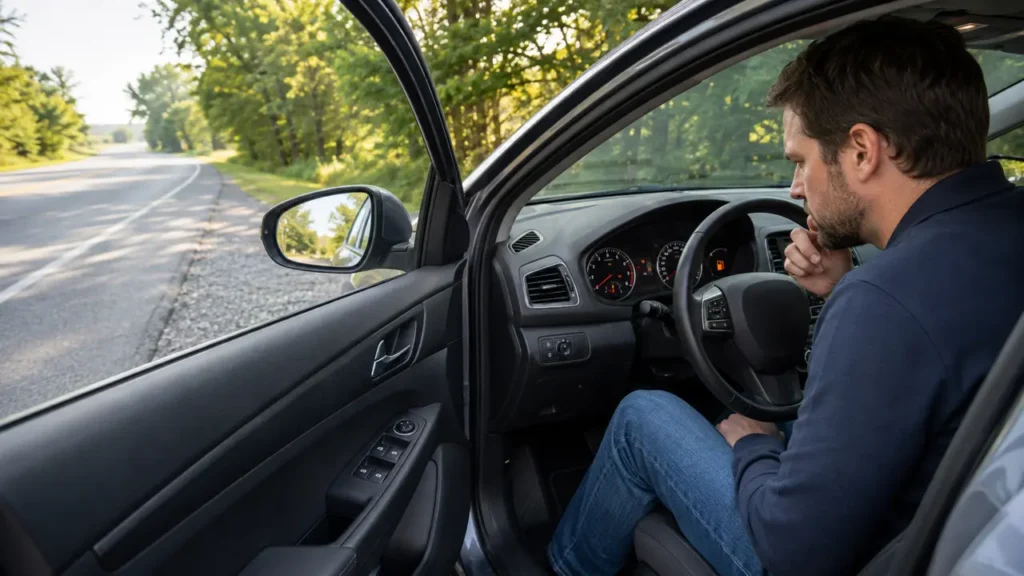
If your car starts and then dies within a few seconds, stop repeatedly restarting it. Park safely, switch off accessories, confirm there is usable fuel, watch the warning lights, and try the spare key if your car has an immobilizer. A loose battery connection, weak electrical supply, security-key recognition problem, incorrect fuel reading, blocked air intake, or an engine-management fault can all create this symptom. If it stalls while moving, smells of fuel, smokes, overheats, or shows a red oil-pressure or temperature warning, stop and arrange professional help.
This guide covers safe observations you can make without opening fuel lines, bypassing security systems, touching high-voltage components, or dismantling the engine. Vehicle procedures differ, so use your owner’s manual as the final authority.
First: make the situation safe
If the engine dies while driving, keep the vehicle pointed straight, signal, and move cautiously off the road when possible. Steering and braking may feel heavier after the engine stops. Do not pump the brake pedal; repeated presses can use the remaining power-assist reserve. Toyota owner guidance similarly advises reducing speed gradually and moving to a safe place if the engine stalls.
- Turn on the hazard lights.
- Shift to Park or Neutral and apply the parking brake.
- Do not keep driving if the engine restarts but stalls again.
- Never test the car inside a closed garage because exhaust can contain deadly carbon monoxide.
- If the vehicle is stopped on railway tracks, get everyone out and move away immediately. Follow the emergency instructions posted at the crossing.
1. Confirm the symptom and when it happens
Make one controlled start attempt in a safe, ventilated place. Note exactly what happens:
- Starts for one or two seconds, then cuts off: key recognition or an engine-control fault is possible.
- Runs only while you press the accelerator: air, fuel-delivery, or idle-control diagnosis may be needed.
- Dashboard and lights also go dark: inspect the battery connection visually and arrange an electrical test.
- Stalls only when put in gear: do not continue testing; transmission or engine-load diagnosis may be required.
- Stalls after warming up: note the temperature and warning lights and book service.
Verification: write down the runtime, warning lights, sounds, outside temperature, and whether the engine was cold or warm. These details help a technician reproduce the fault.
2. Check the actual fuel level
A low or inaccurate fuel reading can make a vehicle start on the remaining pressure and then stop. Check the gauge with the ignition on and consider whether the car is parked on a steep slope. If the gauge is near empty, add only the correct fuel listed in the owner’s manual.
Do not open fuel lines, loosen injectors, siphon fuel, spray starting fluid, or test for fuel with a flame. If you smell raw fuel or see a leak, switch the ignition off, move people away, and contact roadside assistance.
Verification: after adding a small amount of the correct fuel, make one normal start attempt. If it still dies, continue with the non-invasive checks below.
3. Watch the security or key warning
Modern immobilizers can allow brief cranking or starting before shutting the engine down when the key is not recognized. Look for a flashing key, padlock, or security symbol. Remove other electronic keys from the key ring, lock and unlock the car normally, then try the manufacturer-approved spare key.
Do not bypass the immobilizer, bridge relays, or follow wiring hacks. Those steps can damage control modules and weaken theft protection.
Verification: if the spare key starts and keeps the engine running, stop using the suspect key and have it checked or reprogrammed through an authorized service route.
4. Check battery symptoms without disconnecting it
A battery can have enough energy to crank but still suffer a voltage drop that disrupts engine electronics. Before touching anything, turn the ignition off. Look for dim cabin lights, rapid clicking, a slow crank, a clock that resets, or dashboard lights that flicker when the engine dies.
From a safe position, visually check whether the battery is secure and whether a terminal clamp is obviously loose or heavily corroded. Do not remove terminals, short them with tools, touch damaged cables, or approach a swollen, leaking, hot, or frozen battery. Ford notes that automotive batteries gradually lose power and recommends professional testing when battery condition is uncertain.
Verification: have the battery and charging system load-tested. A voltage reading alone does not always reveal a weak battery under starting load.
5. Switch off accessory loads
Turn off climate control, headlights, heated seats, phone chargers, aftermarket amplifiers, and other accessories. Then make one normal start attempt. This does not repair the fault, but it can show whether low system voltage or an aftermarket accessory is contributing.
Verification: if the engine stays running only with accessories off, do not assume it is fixed. Arrange battery, alternator, belt, and wiring checks before normal driving.
6. Inspect the air-intake opening
With the engine off and cool, look only at the accessible air-intake opening and filter-box exterior. Remove leaves, a loose plastic bag, snow, or other material blocking the external intake. Make sure the visible air-filter housing clips are closed.
Do not reach near fans or belts, remove sensors, spray cleaners into the intake, or run the engine with intake parts disconnected.
Verification: after clearing only an obvious external blockage, close the hood and try one normal start. If the engine still dies, leave deeper airflow diagnosis to a technician.
7. Read warning lights and messages
Before starting, most dashboard warning lights illuminate briefly as a self-check. After the engine starts, note which lights stay on before it dies. A red oil-pressure or temperature warning requires immediate shutdown. Toyota’s warning-light guidance describes red indicators as conditions needing immediate attention and advises checking the owner’s manual for the vehicle-specific meaning.
A check-engine light can store a diagnostic trouble code even when the light later turns off. A parts store or repair shop can scan the vehicle without you replacing parts blindly.
Verification: record the exact code and its status—current, pending, or history. A code identifies the system that detected a problem; it does not automatically prove which part has failed.
8. Check for an open safety recall
Some stalling problems are addressed by manufacturer recalls or software updates. In the United States, use the official NHTSA recall lookup with the 17-character VIN. Elsewhere, check the vehicle manufacturer or national road-safety authority.
Verification: confirm the VIN shown in the result matches your car and contact an authorized dealer if an incomplete recall applies. Recall repairs are handled according to the manufacturer’s campaign instructions.
9. Know when to stop troubleshooting
Arrange towing or qualified diagnosis when:
- the engine stalls while the vehicle is moving;
- the problem repeats after one controlled restart;
- you smell fuel, see a leak, smoke, or steam;
- a red oil-pressure or temperature light appears;
- the battery is hot, swollen, cracked, leaking, or sparking;
- the vehicle is a hybrid or EV and displays a high-voltage warning;
- steering, braking, or transmission behavior changes;
- the car has flood, collision, or rodent damage.
Toyota’s current owner guidance says that an engine that becomes difficult to start or stalls frequently should be checked promptly. Repeated restarts can drain the battery, overheat the starter, or worsen some faults.
What a technician may test
A professional may scan control modules, review live sensor data, test fuel pressure, verify ignition and injector control, check charging voltage under load, inspect vacuum leaks, and compare immobilizer authorization data. These checks require model-specific procedures and equipment; they are more reliable than replacing parts based only on symptoms.
Quick verification checklist
- The vehicle is parked safely in a ventilated place.
- The correct fuel is present.
- No fuel smell, leak, smoke, overheating, or battery damage is present.
- The spare key behaves the same or differently—and you recorded the result.
- Warning lights and messages are photographed or written down.
- Any diagnostic codes are recorded before they are cleared.
- The VIN has been checked for recalls.
- A professional inspection is arranged if the engine dies again.
For more safe, problem-focused guides, browse the Solve Fast troubleshooting library. The Cars & DIY Fixes section collects vehicle checks that stay within user-level safety limits.
Sources
